
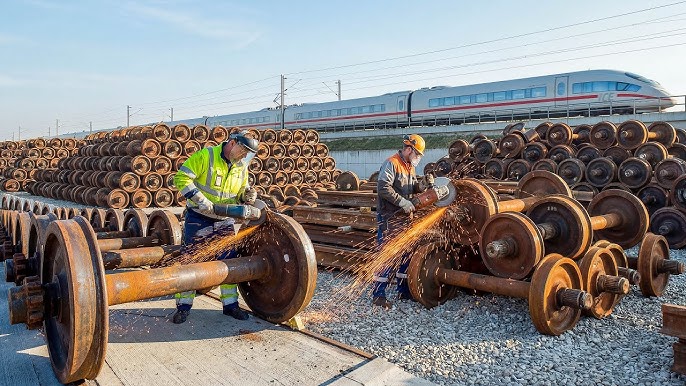
As the global push for sustainability intensifies, the rail industry faces a unique challenge: what to do with the thousands of tons of rolling stock that reach the end of their operational life each year. The traditional image of a “train graveyard”—rusting hulks abandoned in sidings—is rapidly becoming a relic of the past. Today, decommissioning is a sophisticated, high-tech process driven by the principles of the circular economy.
Beyond the Scrap Heap
For decades, the end-of-life process for trains was simple: strip the valuable copper, crush the rest, and send it to a landfill. However, modern rolling stock is a complex assembly of advanced composites, rare earth metals, and hazardous materials. Simply crushing these assets is not only environmentally irresponsible but also a massive waste of financial value.
At OPUS Group, we view a decommissioned train not as waste, but as a resource bank. A single locomotive can contain tons of high-grade steel, aluminum, and copper cabling. By employing “surgical stripping” techniques, we can recover up to 96% of a train’s mass for reuse. This shift from “disposal” to “recovery” is transforming the economics of the industry.
The Role of Digital Twins
One of the most exciting developments in this field is the use of digital technology. Before a single bolt is removed, we create a “digital twin” of the asset. This virtual model allows us to map every component, identifying hazardous materials like asbestos or PCBs safely and efficiently.
“We don’t just tear trains apart; we deconstruct them with the same precision used to build them. This ensures that hazardous materials are contained and valuable alloys are kept pure for the recycling market.”
This data-driven approach also provides our clients with verifiable audit trails. In an era of strict ESG (Environmental, Social, and Governance) reporting, being able to prove exactly where every ton of material ended up—whether it was recycled into new steel beams or repurposed for construction—is a critical business asset.
A Second Life for Components
Not everything needs to be melted down. The most sustainable form of recycling is reuse. Bogies, wheelsets, and even engine components often have years of service life remaining. Through our global network, we refurbish and resell these critical spares to operators in developing markets, extending the lifecycle of the machinery and reducing the carbon footprint of manufacturing new parts.
The future of rail is green, not just in how trains run, but in how they retire. By embracing advanced decommissioning, the industry is proving that the end of the line is just the beginning of a new journey.